West Sumbawa, 13 May 2026 – The morning sun over Benete Village, Maluk District, felt exceptionally warm on Thursday, 30 April 2026. Across the vast expanse of paddy fields, a group of local farmers gathered not just to work, but to celebrate a major milestone. That day marked the Inaugural Harvest Celebration of SRI Organic Farming, a turning point in a long journey that began back in August 2025.
For years, the agricultural land in Benete and Maluk villages within the Maluk District had grown ‘exhausted’, forced to maximize production through heavy use of chemical fertilizers and pesticides. As a result, the soil suffered from high acidity, dropping to a low pH level of 5.5. Farmers found themselves trapped in a cycle of skyrocketing production costs while yields remained stagnant.
Today, however, the landscape tells a completely different story. Heavy, bowing rice panicles signaled a massive surge in productivity, reaching 10.02 tons per hectare. This represents a drastic leap compared to conventional farming methods, which typically yield only 4 to 5 tons per hectare.
Cultivating Independence on Native Land
The initiative, spearheaded by PT Amman Mineral Nusa Tenggara (AMMAN), one of Indonesia's largest copper and gold mining operations, in collaboration with Aliksa Organik, is far more than a technical assistance program; it is a revolution in mindset. Through the System of Rice Intensification (SRI) Organic method, farmers are trained in the core principles of Healthy, Environmentally Friendly, and Sustainable Agriculture (PSRLB).
The primary focus of this program is sovereignty. Farmers are encouraged to stop ‘buying’ soil fertility and instead start ‘generating’ it themselves. Agricultural waste like straw, livestock manure, and wild greenery, previously dismissed as refuse, is now processed into high-quality compost and Local Microorganisms (MOL) liquid fertilizers.
“Initially, I was skeptical. How could farming without chemical fertilizers actually work? We used to believe that more chemicals meant a better harvest. But through this Field School (Sekolah Lapangan), we were guided to reconnect with and care for our soil. We learned how to formulate our own crop vitamins using materials found right around our homes. The results speak for themselves: our soil, which used to be hard and compacted, is now rich, dark, and loose. Our harvest has nearly doubled. Most importantly, we no longer have to worry about the soaring costs of chemical fertilizers. We finally feel like the true masters of our own fields,” stated Hamzah, Chairperson of the Organic Agriculture Presidium of Maluk District.
Innovation Beyond Numbers
This transformation is visible not only in the overflowing sacks of grain but also in the restoration of the local ecosystem. Predatory birds and beneficial insects have returned to act as natural pest controllers, replacing synthetic pesticides. The once-acidic soil has recovered to a neutral pH level of 7, representing a vital long-term asset for future generations of farmers. Furthermore, this positive shift has transcended the senior farming community, successfully sparking enthusiasm among youth groups and the Karang Taruna (youth organization) in Maluk District to actively participate in innovating agricultural cultivation.
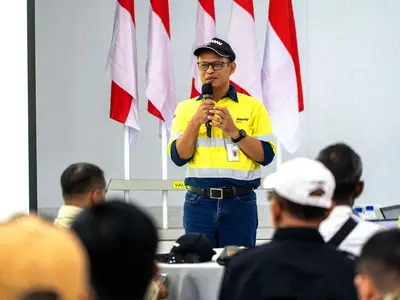
“The SRI Organic program in Maluk District is our structured effort to empower local farming communities with robust technical and institutional capacity. It supports their ability to suppress production costs while driving higher agricultural output and productivity. We hope this program instills fresh perspectives on organic farming and that its scope and achievements can be expanded even further in the future,” expressed Priyo Pramono, Vice President of Policy and Permitting, and Social Impact at AMMAN.
Synergy Towards a Green Sovereignty
The success witnessed in Benete and Maluk villages is only the beginning. With the establishment of the Maluk District Organic Agriculture Presidium, farmers now possess a dedicated forum to share knowledge and strengthen their collective bargaining power. Village-Owned Enterprises (Bumdes) in Maluk are also actively engaged, unlocking significant potential to serve as a new economic engine for West Sumbawa.
“This program serves as an exemplary model of success and a hub for learning, because true success requires a process. These farmers can now become organic farming ambassadors for West Sumbawa, with the hope that this practice can be scaled up to other regions across KSB. I have seen firsthand the stark contrast between conventional and organic plots; even to the naked eye, organic is far superior. What we witness today is proof that innovation and local wisdom can walk hand in hand. We highly commend this collaboration and hope these best practices can be replicated across other villages, positioning West Sumbawa as a pioneer in self-sufficient organic agriculture,” concluded the Regent of West Sumbawa, H. Amar Nurmansyah, S.T., M.Si.
The road ahead is widely mapped out: from securing organic certifications for rice and vegetables, to certifying MOL formulations, and unlocking broader market access. This inaugural harvest celebration delivers a powerful message from Maluk District, that land nurtured with knowledge and care will always reward its people with abundant prosperity.